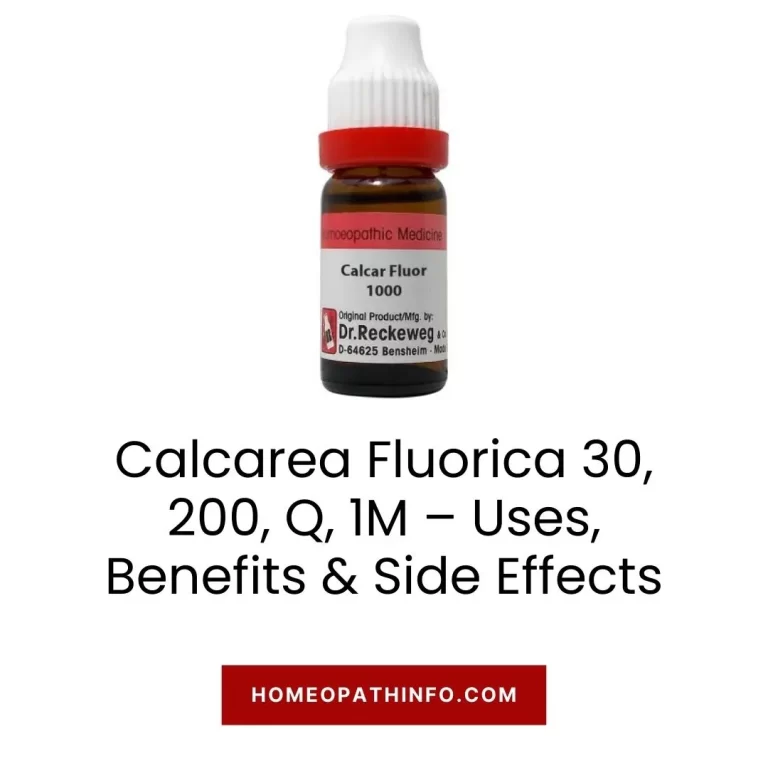
Homeopathic remedies are generally described as low-risk, and most people notice no side effects at all. The reaction homeopaths discuss most often is homeopathic aggravation — a brief, temporary intensification of existing symptoms after a dose, which practitioners read as evidence that the simillimum (the most similar remedy) has been well matched. Some also describe a “healing crisis”: a short flare of old symptoms, discharges, or tiredness as the system re-balances. Both ideas are framed within homeopathic practice rather than as established clinical findings, and anything severe, new, or persistent is not a healing reaction — it needs medical assessment.
What “Side Effects” Means in Homeopathic Terms
In conventional medicine, a side effect is an unintended pharmacological action of an active molecule. In homeopathy, the framework is different. A remedy is selected on the law of similars — similia similibus curentur, “let like be cured by like” — so the substance chosen is one whose proving produced symptoms resembling the patient’s own. Because the remedy “resembles” the illness, any reaction it produces is expected to look like the illness itself rather than like an unrelated drug effect.
That is why the vocabulary is unusual. Homeopaths speak of aggravation, healing reactions, discharge, and return of old symptoms rather than of adverse events. A true pharmaceutical side effect — a rash from an antibiotic, say — has a different mechanism, a different timeline, and a different meaning inside the homeopathic model.
It is also worth remembering that most remedies are diluted far beyond the point at which any original molecules remain, and prepared by succussion (vigorous shaking) at each step of dilution. Homeopaths hold that the remedy’s information, not its mass, does the work. Critics argue the opposite. Either way, the practical point for a patient is the same: reactions attributed to remedies are usually mild and short.
Deal alert: Prime Big Deal Days is on
Right now on Amazon, Prime Big Deal Days brings Prime Day-level prices with free fast Prime shipping. The discount ends [Sunday] — and popular items sell out early.
Buy From Amazon As an Amazon Associate I earn from qualifying purchases.Homeopathic Aggravation: The Classic Reaction
Aggravation is the single most-discussed reaction in homeopathic literature. It is a transient worsening of the symptoms you already have — the cough gets a little harsher, the joint a little stiffer, the emotional state a little rawer — typically appearing shortly after a dose and easing within a short period.
What homeopaths believe aggravation means
- The remedy is acting on the correct symptom picture.
- The potency may be slightly too high for this person at this moment.
- The body is responding, and the direction of the response matters more than the intensity.
What it usually looks like in practice
- A short-lived return of symptoms that had already settled.
- A sense of being “stirred up” — restless, emotional, or unusually tired for a brief window.
- An intensification that resolves on its own without any further dose.
The “Healing Crisis” Explained
The term healing crisis is used more loosely. It describes a period in which symptoms seem to move outward or backward — an old skin complaint reappearing, a discharge, a spell of fatigue, vivid dreams, or a change in bowel habit — before things improve. Homeopaths connect this to the idea of miasm and to the notion that chronic patterns are layered, so that treating a deeper layer can briefly disturb a shallower one.
This is a belief framework, not a measurement. There is no test that distinguishes a healing crisis from a coincidence, a flare of the underlying condition, or the start of a new illness. That ambiguity is precisely why the rule below matters.
Aggravation vs. Conventional Side Effects: A Side-by-Side Comparison
- Cause: Aggravation is attributed to the remedy matching the symptom picture; a conventional side effect is a pharmacological action of a drug.
- Timing: Aggravation is usually described as appearing quickly after a dose and settling quickly; drug side effects often build with cumulative dose and stop when the drug is withdrawn.
- Appearance: Aggravation is said to resemble your own symptoms; drug side effects are usually unrelated to the condition being treated.
- Action taken: With aggravation, a homeopath may reduce potency, lengthen the interval, or wait; with a drug side effect, the prescriber may adjust dose, switch drug, or stop it.
- Evidence status: Aggravation is described in homeopathic practice; researchers report little evidence of it in clinical studies and note that research on it is scarce.
Reactions Not to Ignore
The most important safety point in homeopathy has nothing to do with the pellets. It is delay. Stop and get medical care if you experience:
- Difficulty breathing, chest pain, or a swollen face, lips, or tongue.
- Fever that is high, persistent, or accompanied by confusion, stiff neck, or a non-blanching rash.
- Sudden weakness, slurred speech, vision change, or one-sided numbness.
- Severe abdominal pain, vomiting blood, or blood in the stool.
- Any new symptom that is severe, rapidly worsening, or unlike anything you have had before.
- In infants and children: poor feeding, drowsiness, dehydration, or unusual floppiness.
Also be cautious with products labelled homeopathic that are not highly diluted. Regulators and health agencies have warned that some such products can contain measurable amounts of active ingredients — including heavy metals or botanicals — and can therefore cause genuine side effects or interact with medicines. Liquid preparations may also contain alcohol.
How to Lower the Chance of a Rough Reaction
- Start lower. A modest potency such as a 6C, 12C, or 30C is the usual starting point for home prescribing, with higher potencies left to experienced practitioners.
- Keep intervals generous. Do not repeat a dose simply because you are impatient; the gap between doses is part of the prescription.
- Keep a simple record. Note symptoms, dose, potency, and timing so your prescriber can read the pattern rather than guess at it.
- Tell your whole care team. Your GP, pharmacist, and homeopath should all know what you are taking.
- Never stop prescribed medicine to “let the remedy work.”
How Homeopaths Distinguish a Reaction From a Coincidence
Since there is no laboratory test for aggravation, careful practitioners rely on structure rather than on impression. The usual method is to establish a baseline before treatment and compare against it afterwards.
- A written baseline. Severity, frequency, and timing of each symptom are recorded before the first dose.
- A short observation window. Changes are judged over hours to a few days for acute prescribing, and over weeks for constitutional work.
- Direction of travel. The question asked is not only “did it get worse?” but “did it get worse on the way to getting better?”
- Character of the change. A reaction is expected to resemble the existing symptom picture, not to introduce unrelated new symptoms.
- A clear exit rule. If the change is severe, unfamiliar, or prolonged, the homeopathic interpretation is set aside and medical advice is sought.
The Return of Old Symptoms
Homeopaths describe a second pattern alongside aggravation: the brief reappearance of a complaint that had already settled — a childhood rash, an old digestive sensitivity, a long-gone headache. In the homeopathic framework this is read through the idea of miasm and of layered chronic patterns, where treating a deeper layer briefly disturbs a shallower one.
Functionally, it is treated the same way as aggravation: observe, do not escalate, and do not repeat the dose while a change is still unfolding. The important practical point is that a returned old symptom should be recognisable. A genuinely new symptom is not an old symptom returning, and should not be labelled as one.
What a Good Record Looks Like
If you want your reaction — or your improvement — to mean something, record it before you start. A single page is usually enough.
- The date and the symptom, rated on your own simple scale.
- The remedy, potency, form, and time of each dose.
- Anything else that changed that day: sleep, food, stress, menstruation, travel, other medicines.
- How you felt 1 hour, 6 hours, 24 hours, and one week after a dose.
Over a few weeks this turns guesswork into a pattern. It also gives any clinician you see — homeopath or doctor — something concrete to work from.
When to Stop and Ask for Help
Homeopaths generally agree that some reactions fall outside the healing framework entirely. Stop the remedy, keep the notes, and contact a clinician if a symptom is severe, is worsening quickly, is unlike anything you have had before, or comes with any of the emergency signs listed above. In children and in older adults, the threshold for seeking help should be lower, because both groups can deteriorate faster than the symptom picture suggests.
Frequently Asked Questions
Are homeopathic remedies actually safe?
Highly diluted potencies are widely described as low-risk, largely because little or no original substance remains. The genuine safety concerns in homeopathy are delayed or avoided conventional care, and products labelled homeopathic that contain measurable active ingredients, alcohol, or heavy metals.
How long does a homeopathic aggravation last?
In homeopathic practice it is described as brief — typically a short window after the dose, easing without further medicine. If a reaction is severe, prolonged, or unfamiliar, treat it as a medical matter, not a remedy effect.
Should I stop the remedy if symptoms get worse?
For a mild, familiar, short-lived worsening, many homeopaths advise pausing and noting what happened. For anything severe or rapidly worsening, stop and seek medical advice immediately.
Is a “healing crisis” proof the remedy is working?
No. It is a homeopathic interpretation, not a measurable marker. Improvement over time, judged against a written record of your symptoms, is the more reliable way to assess any treatment.
Can remedies interact with my prescriptions?
Direct interaction is considered unlikely at high dilutions, but that is an assumption rather than a tested guarantee. Always inform your prescriber and pharmacist, and check the label of any product sold as homeopathic.
General educational content; not a substitute for professional medical advice, diagnosis, or treatment. Always consult a qualified clinician for serious or worsening symptoms.